Showing posts with label Lovecraftian lore. Show all posts

Friday, 30 October 2020

A Lovecraftian Halloween lecture

This talk was given to a select audience in honour of Halloween. So His Lordship thought it fitting to reuse here. Happy Halloween, people!


Hello, my name is Lord Bassington-Bassington and I have an obsessive interest in HP Lovecraft.
If this sounds like an introduction to a support group, it is because I desperately need one. But there is no Lovecraftians Anonymous, only support groups for people who have problems with trifles such as drugs or alcohol. Therefore, you good folks will have to be my support group.

So welcome to my talk.

My plan for the next short half-hour or so is talk a little about how HP Lovecraft created his own version of New England. I will also try to explain why it makes sense to see New England as a sand bank in the Danube. There will also be some discussion of racism, which I hope won’t bother you too much.

I was originally going to assume that most of you have at least a cursory knowledge of Lovecraft, since he's unavoidable these days, especially within subcultures that deal with the occult and esoteric, spiritually and musically.

But in case your life went better than mine did: HP Lovecraft was an American horror writer who died in 1937. He wrote for pulp magazines, only having one paperback of his work produced in his lifetime. He is the kind of writer that under normal circumstances would be forgotten. But his literature has qualities that has made it enduring, and today he is both a thriving part of pop culture, from Metallica to South Park. He is also canonized, a collection of his stories released in the Library of the Americas series, and lionized by writers such as Jorge Luis Borges and Michel Houellebecq.
Lovecraft is often reduced to a caricature: A pulp writer who created jungles of eldritch adjectives, jungles inhabited by tentacled god-monsters who came from the depths of space and once ruled over the Earth.

But while his monsters and gods are undeniably interesting, his most fascinating creation is in many ways his own almost magical reimagining of his own environment. And how he used a quite bourgeois and provincial part of America as a springboard to become a kind of cosmic Kafka.
Many writers of fantastic literature prefer faraway, exotic locations. Lovecraft definitely did try his hand at this. He wrote a story set in the Antarctic, another story set on Venus and a bunch set in the lands you can only access in dreams – possibly assisted by narcotics.
But most of his best stories are set in the world he had right outside his doorstep. Because to Lovecraft, New England was a world in itself.

To those of you who aren’t Americans or Lovecraft obsessives, New England is the area to the north and east of New York on the eastern seaboard of the United States. It encompasses the states of Massachusetts, Rhode Island, Maine, Connecticut, New Hampshire and Vermont.
Lovecraft was a typical genre writer. In his own words, he could never write about ordinary people because he was “not in the least interested in them”. He didn’t write about ordinary things either.
But one of the things he learned from more “normal” literature was realism. The New England locales he writes about are extremely detailed and feel quite real. There’s a reason for this: Lovecraft had a keen interest in architecture and history.

One of his favourite tricks was to create horror by conjuring up a feeling of great age in cemetaries and cellars and other constructions. Luckily, New England is one of the few places in America where you can pull that off since it was one of the first parts of America to be settled.
But while he had a fact-based approach, he of course wrote fiction. And one of Lovecraft’s most famous literary devices was to fictionalize already existing places.

His fictitious town of Arkham, site of Miskatonic University where the infamous Necronomicon is kept under lock and key, is usually considered to have been based on Salem. This didn’t take so much work, as Salem – with its history of witch trials – is already spooky enough.
Some more work was needed on Marblehead, a Massachusetts resort town famous for seafood and regattas. But Lovecraft’s imagination turned this quaint town into the setting of unholy holiday rituals from the time before human beings arose. And again, Lovecraft uses his realistic approach. You can follow the path the protagonist in his story “The Festival” takes into Kingsport/Marblehead.
I did this myself when I went a Lovecraftian pilgrimage of sorts about a decade ago. Yes, I did mention I have problems, didn’t I?

The coastal town of Innsmouth, the location of “The Shadow over Innsmouth”, is in Lovecraft’s own words “a considerably twisted” version of Newburyport, Massachusetts.
While the Starry Wisdom Church in the story “The Haunter of the Dark” is based on a now-demolished Catholic Cathedral in Lovecraft’s home town of Providence, Rhode Island. I walked up towards where it used to stand while a hurricane was raging on the same trip. That was quite an atmospheric experience!

As a sidenote, an effect of this is that there is a tiny genre of Lovecraftian travel guides, online and print. There’s also quite a few online, and a new book is in the works through Kickstarter.
Another Lovecraftian trick was borrowing from other writers' creations, and encouraging others borrow from him. This created a web of cross-references which makes his literature more believable. One reason some people think Lovecraft’s fictional grimoire The Necronomicon is real, is that you find references to it so many places. Surely it can’t be made up?
Lovecraft was also a rationalist, and he could use his knowledge of science to create a feeling of the magical and unreal.

One example is his use of the anthropologist Margaret Murray’s book “The Witch-Cult in Western Europe”. In the book Murray argues that the accusations underpinning the witch-trials in early modern Europe were true, in the sense that witches actuallybelonged to a real pre-Christian religion which worshipped a horned god. This thesis was discredited already in when the book came out in 1921. But Lovecraft saw that Murray’s thesis was a great fictional premise and could use Murray’s non-fiction book to make his own fiction more believable.

Another example was the discovery of Pluto in 1930. Lovecraft used this new planet to great effect in “The Whisperer in Darkness”, published the year after. Here Pluto becomes Yuggoth, from whence comes strange aliens infiltrating the woods of Vermont.
Today, using quantum physics to argue that anything is possible is a new age cliché. But when Lovecraft did this to explain magic in “Dreams in the Witch-House” in 1932 this was groundbreaking.

Nothing says “verisimilitude” like giving your short stories scientific footnotes!
If you want a good model for understanding Lovecraft’s New England, I heartily recommend a story by another writer. The writer is Algernon Blackwood, an Englishman most known for his ghostly stories, and the story is “The Willows”.

We know that Lovecraft was inspired by this story because in his essay "Supernatural horror in literature" he writes gushingly about it.

“The Willows” is a simple story: Two friends are canoeing down the Danube river. They make camp on a sand bank on which there is a thicket of willow trees. During the night they become aware that there is some sort of mysterious, supernatural presence in the willows. This presence is never explained, but gives the two friends a glimpse into a larger, terrifying reality.

My feeling is that in Lovecraft's fictional New England is easier to understand if you look at it in the light of this story. If you think of New England as this sand bank in the Danube, with the waters of the cosmos splashing at its shores, eating away at it and one day perhaps submerging it.
Also, like in Blackwood’s “The Willows” Lovecraft doesn’t necessarily give you more than a glimpse of this awe-inspiring cosmos. Instead he goes for the feeling of alien dread, an overwhelming mystery.

This vision of New England as a haven under attack from outside forces feeds into some of Lovecraft’s own personal quirks. He disliked the modern world, wore old-fashioned clothes and called himself Grandpa Theobald. He was also a Tory, and considered himself a subject of the Queen.

Harmless enough, but another side to this was his racism.
To be fair, pretty much everyone was racist in Lovecraft’s time. That’s not the point. The point is that Lovecraft was more racist than was normal for his time, at times ludicrously so.

So for many Lovecraft fans it’s tempting to try to separate his fiction from his racism. This is impossible. A lot of his recurring themes, such as human mixing with non-human to create hybrids, and invasions from alien creatures, are quite racist themes. And I think Lovecraft’s virulent racism is one reason why these horror stories are as powerful as they are.

There’s been a growing debate in recent years about Lovecraft’s racism. Speaking as someone from a country where one of our most famous writers, Knut Hamsun, was a full-fledged Nazi and collaborated with the German occupiers during WWII, I think I can predict that this debate will eventually end up somewhere constructive.

But back to New England. Lovecraft’s fiction is at its most powerful when his cosmic vision of a vast, cold universe is anchored in a New England that he knows very well. It’s an approach I think can be summed up as “think cosmically, write locally”.

Lovecraft was a lifelong atheist and science advocate. So you could perhaps say it’s ironic that he became an inspiration for occultists and magicians, to the point where you got get people like Anton LaVey, Kenneth Grant and many others trying to create real Lovecraftian rituals and spirituality. Aren’t these people missing the whole point?

Quite the contrary, I think they’re getting the point. Lovecraft wanted to create a new myth for a Godless age, just like Tolkien wanted to create a new mythology for England. And just like Tolkien mixed Germanic and Celtic mythology with his own creations, Lovecraft used science and New England to similar effect.

And that people take Lovecraft’s creations seriously to the point where they try to create real spiritualities based on it is proof that he succeeded.

Perhaps that is the ultimate compliment.


Saturday, 10 January 2015

Art Nouveau Cthulhiana


This marvellous artwork was an early Yuletide present from Lady Mju, Lord Bassington-Bassington's better three-quarters, Lady Mju, and was commissioned, of course, from artist Kim Holm, known for his deep delvings into the Lovecraftian. Isn't it grand? With a proper frame, it will grace the walls here at Bassington Manor.

It won't exactly be out of place, either, because there's already enough Lovecraft-inspired artwork, literature and films here to make the place feel a bit like a Mythos theme park already.

But taking a cue from Lady Mju, the latest addition to the Lovecraftian collection needs a name. The winning suggestion will get a prize. For real. Totally. Suggestions in the comments field, please.

Wednesday, 24 September 2014

Non-Lovecraftian Lovecraftiana: A Few Favourites


Great Cthulhu watching over the research material.


H.P. Lovecraft hasn’t only become a cornerstone of horror fiction, he also more or less created his own, instantly recognizable subgenre: one full of scholars hovering on the edge of sanity and hidden cults worshipping ancient beings in far-away places.

So it shouldn’t be surprising that it seems to have become a rite of passage for horror writers to try their hand at penning a story or ten in his style or set in his universe. This has been going on since Lovecraft’s own time, but has escalated in recent years because the lapse of copyright (70 years after Lovecraft’s death in 1937) means that anyone can use the Gentleman of Providence’s material and themes with impunity.

The resulting deluge of Lovecraftiana gives Lord Bassington-Bassington mixed feelings. For as anyone with even the most superficial acquaintance with genre literature will have figured out already, much of it is little value: Uninspired re-tellings of Lovecraft stories done by people who couldn’t write to save their sanity. His Lordship tries to resist buying and reading it all, fearful that all the crap imitations will kill his taste for the real thing, in the same way that watching one too many Elvis impersonators might turn you off The King for good. But as his bookshelves attest he hasn’t really succeeded in conquering his compulsion to buy and read pretty much everything Lovecraft-related.

So is it worth it? Yes. Not only because derivative trash can be fun to read too, but also because sometimes his Lordship comes across material that is superb, reminding one of why he found this stuff appealing in the first place.

A long while ago, Lord Bassington-Bassington was issued a literary challenge by his better three-quarters, Lady Mju: To produce a list of the ten most readable Lovecraftian stories not written by Lovecraft. The challenge was accepted, but like most things here at the Chronicles it took a looooong time.

His Lordship would like to defend himself by pointing to the sheer amount of reading necessary to complete this task, but that’s really dogwash. The real reason for the slowness is that Basset hounds are best at sleeping on the sofa.


But anyway, here it is: Lord Bassington-Bassington’s ten favourite Lovecraftian stories written by someone other than ol’ Grandpa Theobald himself. This is not to be taken as some sort of attempt at some sort of Lovecraftian canon, they are merely some of His Lordship’s personal favourites. The stories are also not presented in any particular order.

1. “A study in emerald”
By Neil Gaiman

Neil Gaiman pays homage to Sherlock Holmes and the Great Old Ones at the same time by creating a Victorian world where the Cthulhu and his compatriots have successfully conquered the world. The result is fantastic, and a lot of fun. Does humour belong in Lovecraftiana? Neil Gaiman certainly seems to think so, and it’s hard to disagree with him.

2. “Notebook Found in a Deserted House”
Robert Bloch

It’s hardly surprising that the best attempts at writing Lovecraftian tales come from people who knew how to write already, and Bloch (best know for the Hitchcock-adapted Psycho) sure knew his way around a typewriter.

Robert Bloch has actually written a lot of Lovecraftiana, and this is perhaps not even the one that contributes the most to Lovecraft’s Mythos. But it is a favourite of Lord Bassington-Bassington’s: A quite straightforward, sometimes a bit silly but nevertheless terribly effective, thriller. One of few stories His Lordship has read which actually made his pulse race even if he was lying down – and had read the story several times before.

3. “The Strange Dark One”
Wilum H. Pugmire

No such list would be complete without “Captain Pugmarsh”, the world’s leading Lovecraftian gay punk Mormon. Not content with penning the occasional Lovecraftian tale, Pugmire writes Lovecraftiana full-time. In the process he has created his own Lovecraftian setting, Sequa Valley in the Pacific Northwest. The results definitetely transcend the normal fan fiction, darkly decadent and dream-like.

This is His Lordship’s favourite Pugmire story, not least because it revolves around a bookshop. More stories should revolve around bookshops. Perhaps all of them.

4. “The Faces at Pine Dunes”
Ramsey Campbell

Like W.H. Pugmire, Campbell has created his own locales, around the river Severn in eastern England, and produced a cycle of Lovecraftian stories set there. As Campbell himself readily admits most of those are pretty run-of-the-mill (some of them are juvenile works), but “The Faces at Pine Dunes” is something else.

Campbell’s clever use of British mythology creates a coming of age-story that manages to use classic Lovecraftian motifs while still having a totally fresh feeling.

5. "There Are More Things"
Jorge Luis Borges

It seems astounding to think that a Nobel Prize laureate actually penned a story dedicated to H.P. Lovecraft, but then Borges was possibly the coolest writer who ever lived.

This is very minimalistic and clever re-working of some key Lovecraftian themes. And even if Borges himself seems to have been a bit ambivalent about the story, it is probably worth about a dozen of those anthologies of Lovecraftiana being churned out these days.


The wall here at Bassington Manor.


6. “The Courtyard”
Alan Moore

Alan Moore is one of the most important people working in comics (or “graphic novels” as pretentious types would have you call them) but this is a normal black letters on white background-based short story. And a pretty superb one, dealing with punky cults and linguistic horrors.

True to Mr. Moore’s day job “The Courtyard” has been adapted as a comic, and forms the first part of Neonomicon. It’s not bad at all, but one should probably skip the second part, which descends into the usual trap of sex and monsters which often afflicts attempts to make Lovecraft more “contemporary” and “cutting edge”.

7. “Furierna från Borås”
Anders Fager

Lord Bassington-Bassington doesn’t really like reading Anders Fager. Quite simply because Fager’s fiction makes him feel uncomfortable. But then, that’s part of the whole point of horror fiction, isn’t it? So let’s say it’s a compliment. Simply put, Fager transplants Lovecraftian themes to modern-day Sweden.

As for Lord Bassington-Bassington’s grumblings about disgusting human copulation in the entry above, there are no rules without exceptions. Fager’s use of sexual elements works like a charm. Or perhaps a curse. And speaking of curses, Fager’s international recognition is bound to be hampered by the fact that his stories are only available in Swedish. International publishers take note.

8. “The Last Feast of Harlequin”
Thomas Ligotti

While Lord Bassington-Bassington dislikes Anders Fager, he finds Thomas Ligotti positively repulsive. But there is no way around him. As Edgar Allan Poe was the most important horror writer of the 19th century, and Lovecraft of the 20th, Ligotti is the most important horror writer working today.

While Ligotti is mostly (in)famous for his nihilistic “corporate horror” stories, his Lovecraftian works are among the best ever produced. “The Last Feast of Harlequin” might not even be the best of the bunch, but as it is essentially a deft re-telling of Lovecraft’s “The Festival” (which again is a re-telling of Arthur Machen’s “The Happy Children”) it instantly found its place in His Lordship’s heart.

9. “The Burrowers Beneath”
Brian Lumley

Lord Bassington-Bassington has an ambivalent relationship with Brian Lumley’s Lovecraftian stories, which tends to be depressingly derivative when he tries to stay true to Lovecraft. Lumley is more enjoyable when he writes about his supernatural investigator Titus Crow, a sort of occult Sherlock Holmes, and just does what he pleases to the Lovecraft mythos – sometimes making an awful mess of things.

This is a bit long for a short story, which is why the excerpt “Cement Surroundings” tends to appear in anthologies (also because its faux-Lovecraftian tone fits in better) but this is shameless, pulpy fun.

10. “The Hounds of Tindalos”
Frank Belknap Long

Frank Belknap Long’s little tale of time-travelling perfectly encapsulates H.P. Lovecraft’s concept of “cosmic horror”. All in all, this is a superb Lovecraftian story. All it needs to achieve perfection is a more accurate description of the Hounds. You know, something about the ears and jowls and such. Come on, that’s not too much to ask is it?


So there you have it, ladies and gentlemen. A small list. What next? A list of Lord Bassington-Bassington's favourite Lovecraftian films, perchance?

Friday, 6 June 2014

Micro Presses, Micro Books

A micro press should issue micro books. And now Valentine & Valentine have produced a most appropriate title.


This tiny tome, a short discussion of the aliases used by TE Lawrence (you know, the one of Arabia) is so small and well made (sown spine and everything) that it is hard to wrap one's head around it.

So to show its size, here is the book next to some everyday objects.


What? You mean straw boaters, bow ties and statues of Great Cthulhu aren't everyday objects for you? Then surely it's time to reexamine your life, Sir!

Saturday, 2 November 2013

Lovecraftian film favourites

There's a steady stream of Lovecraft flicks trickling out these days. Most of these are ultra-low-budget fan adaptations who actually tend to be better than the major movies, because they tend to stick more closely to Lovecraft's original stories. Still, for someone like Lord Bassington-Bassington, whose approach to Lovecraft is through an interest in the numinous they tend to leave a bit to be desired. For frankly, very few of these films manage to maintain the sense of the mystical and otherworldly that one gets from Lovecraft's best stories.

Lord Bassington-Bassington was a bit disappointed by the recent adaptation of The Whispererer in Darkness. For instead of cosmic horror, the creators seemed to want a science fiction adventure film. As an aside, Lord Bassington-Bassington has actually found that Whisperer is better on the second watching, as one won't be disappointed by what one gets. And anyway, it made His Lordship read a whole biography of Charles Fort.

But some films really manage to maintain the mystical and mysterious. So without further digressions here's a few of His Lordship's favourite short Lovecraft adaptations.


Nyarlathotep was one of the first Lovecraftian amateur productions Lord Bassington-Bassington ever saw, and it still has a special place in his heart. The film is available on DVD as part of Lurker Films' Lovecraft Collection, and is an essential addition to any Lovecraftian household.


Sweden is a happening place for Lovecraftian adaptations, apparently. This production is also available on DVD, which includes some spiffy behind-the-scenes features, and has already found its way to the shelves here at Bassington Manor. Lord Bassington-Bassington would like to claim that this is part of his policy of supporting independent artists, but in reality it might be mostly due to His Lordship's sad collector's mania.

Oh, go and see the film Nightgaunts too, by the same people.


Alexander Pavlenko delivers an excellent interpretation of Lovecraft's story "The Temple", Lovecraft's treatment of the Atlantis myth. And while on the subject of lost worlds, Mr. Pavlenko's meditation on Jewish life in Russia (or is it the Ukraine?) is certainly worth seven minutes of your time. See it here.


And looking forward, Lord Bassington-Bassington suspects that the new film Miskatonic University might be worth seeing.

Perhaps it's time for another Lovecraftian film festival...

Sunday, 15 September 2013

Nightmarish reviews


About a decade ago, Lord Bassington-Bassington fell asleep while reading a collection of tales by Clark Ashton Smith – and ended up being awakened by the sound of his own screams. Realizing that this might be the ultimate compliment for a writer of weird (or horror) fiction, this experience has inspired His Lordship to launch a completely new form of literary criticism.

The Hypnocritical Method is deceptively simple: One reads a book, goes to sleep and later recounts the dreams the book inspires. In short, one gets one's subconscious (if such a thing exists; Lord Bassington-Bassington doesn't really buy all this Freudian stuff) to do the work. One could of course insinuate that only a Basset Hound could come up with a form of literary criticism where sleepi is essential to the method. But such insinuations will be sharply rejected by Lord Bassington-Bassington - before His Lordship goes back to dozing on the sofa.

Reading Joseph S. Pulver, Sr's Blood Will Have Its Season on a recent trip to Copenhagen (a trip which might have coincided with Rome playing there) gave Lord Bassington-Bassington some rather magnificent nightmares. The first night, spent in a comfortable cabin on a huge ship, brought on three distinct dreams.

Mr. Pulver (top) and his magnificent moustache (bottom)

The first dream was of a poltergeist phenomenon, and a rather spooky one at that. It didn't help that His Lordship woke up at 1 a.m. because the television had turned itself on.

The second was of three men dressed as Sikhs. Sadly, Lord Bassington-Bassington doesn't remember much of this dream. He hopes it was creepy.

The third was of meeting weird writer W.H. Pugmire on the bus. It possibly has something to do with Mr. Pugmire being referenced in the book, but also with Lord Bassington-Bassington having long wanted to meet "The Queen of Eldritch Horror".


Mr. Pugmire. About to embark on a bus journey?

The next night had a truly beautiful rainstorm raging outside the hotel window, and brought on an epic (or perhaps just a bit long-winded) dream about vampirism. Splendid!

Lord Bassington-Bassington, who actually has a past as a literature student, could of course share his opinions about Mr. Pulver's literary style, reference the author's inspirations (Lovecraft etc), discuss the standard of editing and proofreading of the book and so on.

But to heck with that. Let's read, sleep – and dream. And perhaps wake up screaming.

Blood Will Have Its Season rates four sweat-soaked pillows out of five. Get it here.

Sunday, 7 April 2013

On collecting Lovecraftiana


"Is this the final exorcism/Of an obsession"

As someone who, well, loves H.P. Lovecraft, and has a tendency to gather small topical book collections, Lord Bassington-Bassington has acquired a decent assortment of books related to The Gentleman of Providence through the years. So it shouldn't be surprising that there is a separate bookshelf here at Bassington Manor dedicated to Lovecraftiana: Writings by Lovecraft, about Lovecraft, inspired by Lovecraft and writings that inspired Lovecraft.

One could perhaps lay down the claim that this is the largest collection of Lovecraftian titles in Norway, and invite challengers to a geek-off. But the question is whether this shelf is something to be ashamed rather than proud of. There are plenty of times that Lord Bassington-Bassington has felt that his Lovecraft obsession was a bit of an embarassment.

One could, you know, become a minor expert on some author that normal adults have actually heard of.


Then after all, His Lordship didn't choose to become obessed with Lovecraft - Lovecraft chose him.

So perhaps this post is as much an attempt to gather Lord Bassington-Bassington's thoughts about collecting Lovecraftiana. Some thinking about this is a real necessity these days, when the market is flooded by books cashing in of the fact that the copyright to The Gentleman of Providence expired a few years ago. The growing interest in Lovecraft in popular culture (especially films) also contributes to this. Perhaps a few words about His Lordship's collection of Lovecraftian DVDs later.

The trick, as in so many other things, is to know when to stop. Much of what is released is, frankly, so Dogawful that it's a waste of money and shelf space to buy and store it, and a soul-killing effort to actually read it. The trick is to search out the gems. This will be even more important as the Lovecraftian juggernaut rolls on.


So there, dear reader, you have it. Lord Bassington-Bassington's shelf of shame. Or pride. Or whatever. Now let's see if something similar can be done with Lord Bassington-Bassington's collection of style books...

Monday, 24 December 2012

Feline Yuletide greetings


With catnip deck the temple doors,
And to the gods a fat mouse offer--
Tonight our annual praise outpours
In pious purrs that mock the scoffer.

Let not a claw disturb the bliss,
let not a back in scorn be vaulted,
Lives there a cat with skeptic hiss
Or meow for worship so exalted?

– H.P. Lovecraft

The Gentleman of Providence was, of course known for his fondness for felines, and the poem above was found in this delightful little pamphlet.


And what better soundtrack to accompany the reading than the cosmic sounds from the feline companion of ambient maestro Pär Boström?


Monday, 3 December 2012

A tripartite nature


"I should describe mine own nature as tripartite, my interests consisting of three parallel and dissociated groups – (a) Love of the strange and the fantastic. (b) Love of abstract truth and of scientific logic. (c) Love of the ancient and permanent. Sundry combination of these three strains will probably account for all my odd tastes and eccentricities".

H.P. Lovecraft

Friday, 30 November 2012

S(ermo)-nial

Lord Bassington-Bassington's good friend Mr. Huseby has a new video out for his project S(ermo) III. His Lordship thinks it's splendid stuff, and very seasonal, as the Yuletide is Lovecraft season here at Bassington Manor.

Sunday, 9 September 2012

The things one misses...

...because one didn't know about them. For who can resist a good moustache? Certainly not Lord Bassington-Bassington.


Thanks to Trader Magnus for the tip.

Monday, 20 August 2012

Happy birthday HPL!

Happy 122nd birthday, O Gentleman of Providence!


Study of Grandpa Theobald by Kim Holm. Who seems to be still alive. Those Basset assassins sure do shoddy work.

Saturday, 18 August 2012

To pick(man) a fight


As these Chronicles have previously reported, Bergen-based comic artist Kim Holm has been working on an expanded version of his excellent adaptation of H.P. Lovecraft's short story Pickman's Model.

The new edition, which has just fallen into the paws of Lord Bassington-Bassington, has several new pages which seem to be chiefly devoted to studies of the architecture of Boston. This is a great enhancement to the story, and it's not just because nothing builds the Lovecraftian atmosphere like some proper New England brickwork and gambrel roofs. For Pickman's Model as written by Lovecraft is, of course, a long monologue and Mr. Holm's previous adaptation suffered a bit from this. But with the updated edition the monologue is broken up a bit. There is less talk, more thatch, and things start to really work.

This is a Lovecraft adaptation as it should be: Faithful yet creative. It captures the Gentleman of Providence's bleak vision perfectly. In fact, this might well be the best adaptation of a Lovecraft story that Lord Bassington-Bassington has seen, and His Lordship is a somewhat compulsive collector of Lovecraftiana.


The proper release is at the end of August, through online shop Indyplanet. There is little information online so far, but Mr. Holm's own website could also be a place to find relevant information soon.

It is hard to recommend this book enough. Not only is it eminently worth having, but one can also support a true graphic artist. An artist who have even done some excellent studies of Lord Bassington-Bassington, and who is also involved in other matters Lovecraftian.

That said, this release does not come without a bit of drama.

The press release - in Norwegian, and not available online - includes a somewhat oblique shot aimed at none other than Lord Bassington-Bassington himself, as explained by Mr. Holm, in the postcard below.


We realize that this is in Norwegian and needs a bit of inside information for outsiders to work out what's going on, but in short, Mr. Holm has mentioned Michel Houellebecq's description of Lovecraft as a misanthrope in the press release. As Mr. Holm knows full well that we here at the Chronicles disagree with Houellebecq's thesis (Lord Bassington-Bassington maintains that Houellebecq's book about Lovecraft is an attempt to reshape Lovecraft in the french writer's mould) Mr. Holm is clearly anticipating a fight.

"Bring it on?"

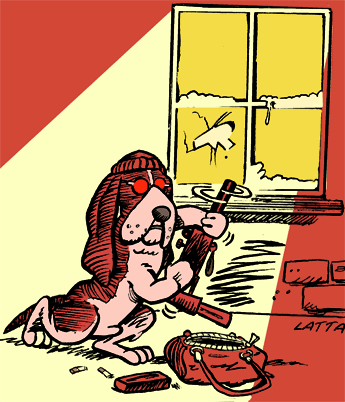
Indeed, Sir! Lord Bassington-Bassington is about to dispatch a team of highly trained Basset assassins - so-called Bassassins - to Bergen. His Lordship recommends that Mr. Holm start glancing over hs shoulder when he is out and about. Well, over his shoulder and then downward, as Bassets are low-slung. So, in case the Bassassins fail in their task (Bassets are known to be a bit hard to motivate) all this awkward glancing is sure to give the damn cartoonist chronic back problems. Hah!


(A Basset assassin - Bassassin - preparing for his mission. Picture by Josh Latta.)

Friday, 17 August 2012

Fortean tidings

There are many things that Lord Bassington-Bassington feels the need to investigate closer, but hasn't gotten around to for lack of time (or due to sheer laziness). One of the things near the top of His Lordship's list is to take a closer look at the Fortean Times and the man whose name it bears, Charles Fort.


Lord Bassington-Bassington's reservations towards both man and magazine is largely a question of doctrine. On one hand, His Lordship loves everything that is weird and doesn't fit into established views of the world. As such, Mr. Fort's chronicling of unexplained phenomena is right up the alley in front of Bassington Manor.

On the other hand, His Lordship is a skeptic and therefore refuses to believe in anything that doesn't fit into a beaker.

The reservations, however, were recently trumped by three factors.

The first is that Lord Bassington-Bassington has been re-watching The Whisperer in Darkness, a film that, despite some initial disappointment, His Lordship has learned to enjoy. In this, Charles Fort makes an intriguing appearance.


The second is that with a theme issue dedicated to the undisputed master of the ghost story, M.R. James, and a cover like this, how can a poor Hound resist?


The third, and most important factor, though, is that it would border on the criminal for Lord Bassington-Bassington to ignore the work of someone with such a magnificent moustache as that of Mr. Fort.


So a magazine is in the mail, it seems.

Friday, 15 June 2012

A tentacular spectacular

Lord Bassington-Bassington has tried his paw at sponsoring a couple of Kickstarter projects. It's a great way of helping out projects that interest you. But it isn't everyday that a Kickstarter project that combines two of His Lordship's biggest obsessions, namely Tiki culture and the Lovecraftian...


Lord Bassington-Bassington is already sponsoring this project. But then, if you know anything about His Lordship, you already knew that.

Monday, 23 April 2012

Lovecraftian book news

Things move slowly at the Chronicles these days. Lord Bassington-Bassington is, as usual, rather un-occupied (unless you count loafing on the sofa here at Bassington Manor as an occupation) but His Lordship's secretary has to earn his keep. As a result, the Chronicles tend to be neglected. We apologize for this - we'd like to say something like "reality is a bitch", except here at Bassington Manor, "bitch" is considered a high compliment.

So here is an attempt to make up for the neglect on at least one front, by looking at some of Lord Bassington-Bassington's Lovecraftian library acquisitions of the last few months. As usual, we here at the Chronicles tend to focus on the small press, as major publishing companies seem to do very well without promotion on obscure blogs.


Wilum Hopfrog Pugmire, possibly the most entertaining practitioner of the Lovecraftian tale alive today, has a new collection of short stories out. And while Lord Bassington-Bassington has barely dipped his paws into them yet, they look very promising indeed.


Jason Thompson's graphic adaptation The Dream-Quest of Unknown Kadath and Other Stories, which Lord Bassington-Bassington helped fund, is out and is a rare delight. Mr. Thompson's adaptation of
"The Strange High House in the Mist" is worth the price of the book alone, and every reading sends Lord Bassington-Bassington into melancholy dreams of his own visit to Kingsport some years ago. To support struggling artists, His Lordship suggests you get it directly from Mr. Thompson.


It is also available with a beautiful poster, which we suspect will look great on the wall of Bassington Manor.


The most intriguing release, though, is without a doubt this ultra-limited translation of Lovecraft's "The Festival" into Norwegian, done by none other than Lord Bassington-Bassington's own secretary, and cover by accomplished Lovecraftian artist Kim Holm.

This is the first publication of Lord Bassington-Bassington's own small press venture, Bassington House, and we hope there will be more releases in the future.

Wednesday, 22 February 2012

Fezzy feline


There's been a bit of a Luciferan vibe on the Chronicles lately, and Lord Bassington-Bassington thinks there's time for a bit of balance by plugging an Abrahamic creed instead. So what could be better than a feline in the ultimate Islamic headgear, incidentally also providing proofs that some cats truly match their human companions?


Islamic cat etiquette as demonstrated by Sheik Nazim.


While Muslims tend to have problems with canines, cats hold a special position in Islam, especially within Sufism, as is elucidated in this article.

Thousands of Sufi stories include cats; lovely stories such as shaykh Ashraf's Madrasa cat, which helped the teachers to bring order to the school, even sacrificed itself for the sake of the dervishes-(disciples), or the tale of the Sufi master from Baghdad, Shaykh Abu Bakr al-Shibli (d. 945) who was seen by one of his friends in a dream when he passed away, On being asked what Allah had done to him, he said that he had been granted admission to Paradise, but was asked by Allah if he knew the reason for this blessing. Shaykh Shibli enumerated all his religious duties but none of his acts of piety had saved him. Finally Allah asked him, ‘Do you remember the cold day in Baghdad when it was snowing and you were walking in your coat when you saw a tiny kitten on a wall shivering with cold, and you took it and put it under your warm coat? For the sake of this kitten We have forgiven you.’


Lord Bassington-Bassington feels quite certain that The Gentleman of Providence would have enjoyed this story.

Monday, 10 October 2011

A model adaptation


As His Lordship is currently in the mood for graphic art adaptations of Lovecraft, Lord Bassington-Bassington thought it appropriate to bring the world news of an exciting Lovecraftian development here in Norway.

Graphic art maestro Kim Holm (who, among other things, have produced wonderful studies of none other than Lord Bassington-Bassington himself) has just released the first version of his adaptation of the Lovecraft short story "Pickman's Model".


The first version can be purchased here, and if you are a Lovecraft fanatic like Lord Bassington-Bassington you will want this gem in your collection. Here at Bassington Manor, we will soon need a separate bookshelf just for His Lordship’s Lovecraftiana.

Those of a less obsessive nature can read the work for free on the Interwebs.


But Lord Bassington-Bassington is really looking forward to the full version, which is promised in November.

Friday, 23 September 2011

Kicking for Kadath

Lord Bassington-Bassington has so far participated in one Kickstarter project, with great results. In short, it seems like a great way to both contribute to a worthy cause AND save money at the same time.

And given his love of most things Lovecraftian, perhaps this is something His Lordship should support?

Monday, 19 September 2011

In Praise of Lighthouse Keepers


While there's an explosion of Lovecraftian cinema these days, it's not every day that a Scandinavian film inspired by Lovecraft is produced. In fact, the Swedish Fyren produced by Bigbelly Films, is probably the first truly Lovecraftian film in Scandinavian history. And luckily for the non-Scandies out there it has also been given English subtitles and released internationally (in selected webshops anyway) under the title Keeper of the Light.


Keeper of the Light is a short film, shot near one of Sweden's great lakes, and like almost all truly interesting Lovecraftian films it’s a decidedly low-budget affair. The trailer should give the prospective viewer some idea of what he (or she) is in for.


While the opening captures that truly elusive Lovecraftian atmosphere.


It would be an exaggeration to say that this is a film without flaws. Moments of Lovecraftian, numinous horror are offset by moments where the budgetary constraints really show. But not only is it very enjoyable (and at times very creepy), it is also a very promising start for Scandinavian Lovecraftian cinema. This film is a treasure for anyone with a Lovecraftian soul.

Oh, and Lord Bassington-Bassington would like to extend his thanks to Van der Graaf Generator for the title to this blog post.